
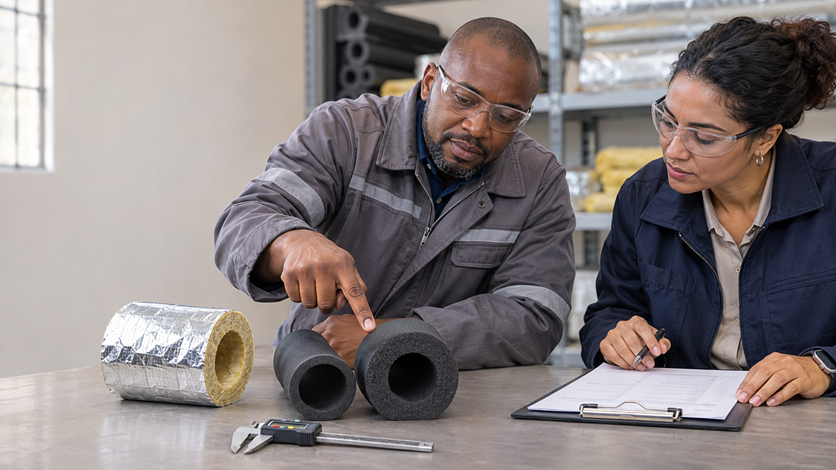
If you are in need of replacement insulation, a photo or old sample can help initiate the conversation. At Insulpro we also advise looking at the application and specification as materials that look similar may have different limits to their performance.
We provide thermal and acoustic insulation for many applications. When selecting a replacement, you need to know what the original system was intended to do and if those needs still apply.
Why appearances can’t guarantee fitness
It is not possible to determine the full specification of a material from its colour or texture. For example, two sections of black foam may have different temperature limits, dimensions or requirements for external protection.
The same principle applies to glass wool insulation and to mineral wool products. Appearance alone is not proof of the required thermal performance or that it is facing or suitable for a particular installation.
We recommend you keep any packaging, product codes and previous quotations you may have. These details provide a better starting point for a replacement inquiry than something that looks the same.
If the original material is anonymous, please let us know. We would rather discuss the missing information than make a recommendation on an assumption.
What information supports to understand the application?
We need to know where the insulation is going to be used and what conditions it is going to be exposed to. The insulation requirements for a chilled water line are not the same as for hot equipment.
Collect what you can before you call us:
– The size of the equipment or building involved.
– Operating temperatures and cleaning cycles are normal.
– Dimensions and existing insulation thickness.
– Exposure to indoor or outdoor conditions.
– Clear photos and specifications are available.
For duct insulation, include existing facing and any space limitations. Determine connections or access points that influence the shape of the replacement pieces for tank insulation.
We also recommend you inform us of the reason for replacement. Accidental damage, repeated moisture and a change in operating conditions give rise to different questions.
Why the Stuff Around Is Important
We consider the replacement to be a component of an insulation system. The main material, its joints, supports and protective finish should work together.
Our insulation adhesives and related products are used in a wide range of applications but compatibility checks are still required. Not all foams, facings or operating temperatures will be suitable for a convenient adhesive.
The protective arrangement also includes sheet metal cladding. When you change the insulation underneath it, you should look at the condition and detailing of the outer layer.
For cold systems it is advised to check the vapour barrier on the repaired joints. In our overview of insulation systems we discuss why preparation and protective finishes belong in the same discussion as material selection.
How we recommend you prepare a replacement request
We suggest separating verified information from information that still needs to be checked. It’s easier to discuss appropriate products without mixing an estimate with an approved spec.
Our branches in Johannesburg, Cape Town and Durban stock a wide range of insulation products. This includes elastomeric foam, fibreglass products and mineral wool, together with finishing and protection materials.
If the existing system is specified by an engineer, please provide us with that document. If the conditions have changed, ask the responsible designer to verify if the original requirements are still appropriate.
Please confirm the product, dimensions and accessories required for the full repair before ordering. Retain the resultant specification with your maintenance records so that the next replacement does not have to begin from square one.
Send us your application details and available photos to discuss needed materials for your project.